4. Modeling experimental replicates#
Imports#
from estim8.models import FmuModel
from estim8.error_models import BaseErrorModel, LinearErrorModel
from estim8 import visualization, datatypes, Estimator, utils
import pandas as pd
import matplotlib.pyplot as plt

# load and init model
SimpleBatchModel = FmuModel(path=r'../tests/test_data/SimpleBatch.fmu')
# import datasheet
data = pd.read_excel(r'SimpleBatch_Data.xlsx', index_col=0, header=[0,1])
data.columns = data.columns.droplevel(1)
data
| Time | X | S |
|---|---|---|
| 0.0 | 0.176200 | NaN |
| 0.1 | 0.318313 | NaN |
| 0.2 | 0.285270 | NaN |
| 0.3 | 0.218600 | NaN |
| 0.4 | 0.248210 | NaN |
| ... | ... | ... |
| 9.6 | 4.885956 | NaN |
| 9.7 | 4.807351 | NaN |
| 9.8 | 5.167874 | NaN |
| 9.9 | 5.220779 | NaN |
| 10.0 | 5.065959 | 0.0 |
101 rows × 2 columns
4.1 Parameter Mapping#
In Estim8, model replicates are defined using a parameter mapping, which defines a hierarchy tree of global and replicate-specific (“local”) parameters.
# define replicate IDs
replicate_IDs = ['1st', '2nd']

# define an empty list for replicate specific parameters
mappings = []
# define a different initial substrate concentration for the 1st replicate
mappings.append(utils.ModelHelpers.ParameterMapper(
    global_name='S0',
    local_name='S0_1st',
    replicate_ID='1st',
    value=15
    )
    )


# define replicate specific initial biomass concentrations
x0_vals = [
    0.11,   # 1st
    0.085   # 2nd
]

for rID, value in zip(replicate_IDs, x0_vals):
    mappings.append(
        utils.ModelHelpers.ParameterMapper(
            global_name='X0',
            local_name=f"X0_{rID}",
            replicate_ID=rID,
            value=value
        )
    )

parameter_mapping = utils.ModelHelpers.ParameterMapping(
    mappings = mappings,                                # the list of ParameterMappers
    replicate_IDs=replicate_IDs,
    default_parameters=SimpleBatchModel.parameters      # default model parameters
)

# display the mapping
parameter_mapping.mapping
| local name | value | ||
|---|---|---|---|
| global name | replicate ID | ||
| Ks | 1st | Ks | 0.010 |
| 2nd | Ks | 0.010 | |
| S0 | 1st | S0_1st | 15.000 |
| 2nd | S0 | 10.000 | |
| X0 | 1st | X0_1st | 0.110 |
| 2nd | X0_2nd | 0.085 | |
| Y_XS | 1st | Y_XS | 0.350 |
| 2nd | Y_XS | 0.350 | |
| mu_max | 1st | mu_max | 0.400 |
| 2nd | mu_max | 0.400 |
The ParameterMapping object is used to get the correct parameter set corresponding to a replicate_ID using its class method replicate_handling.
parameters_1st = parameter_mapping.replicate_handling('1st')
print(f'Parameters 1st: \n {parameters_1st}')

# run a simulation with parameters of 1st replicate
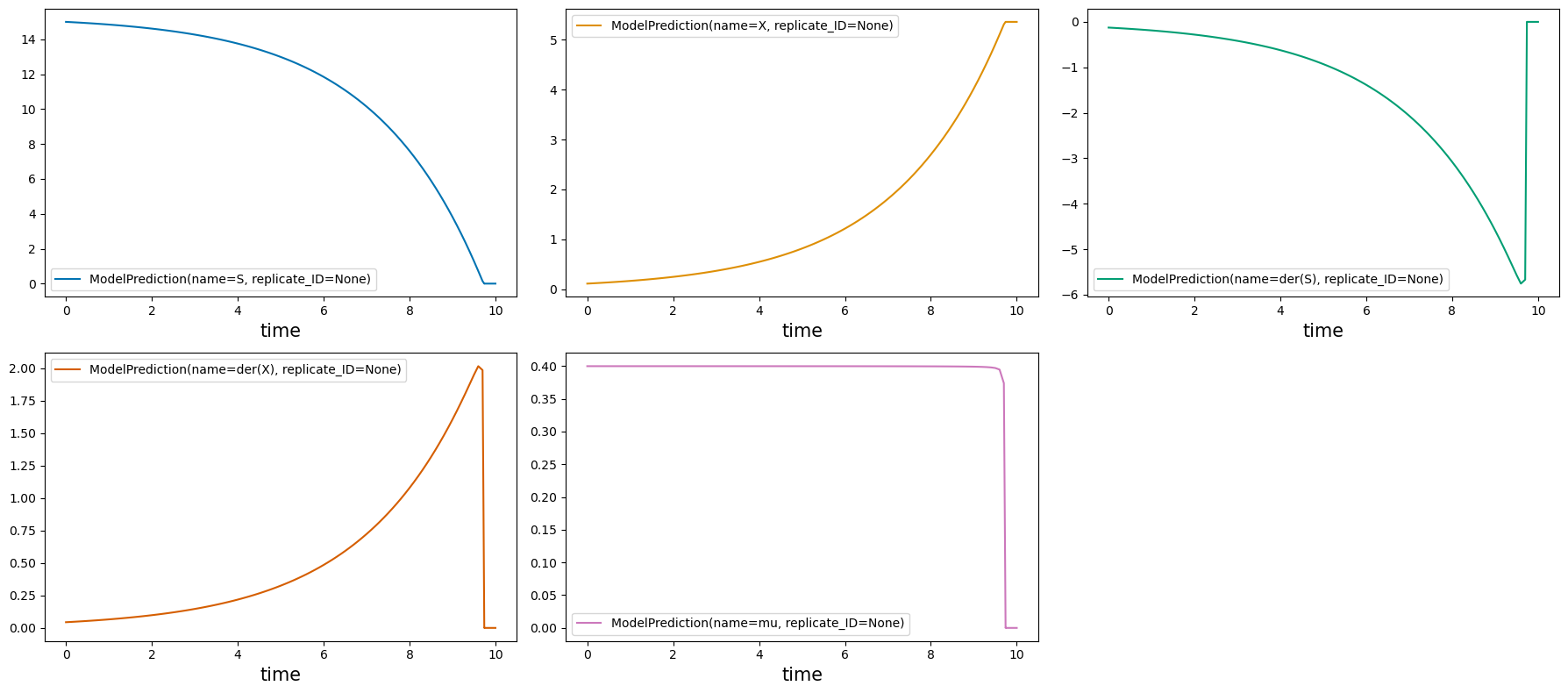
sim = SimpleBatchModel.simulate(0, 10, 0.1, parameters=parameters_1st)
_= visualization.plot_simulation(sim)
Parameters 1st:
 {'Ks': 0.01, 'S0': 15, 'X0': 0.11, 'Y_XS': 0.35, 'mu_max': 0.4}
You can also pass a dictionary of parameters different to the default parameters of the ParameterMapping, but always refer to the local name of a parameter:
parameters_2nd = parameter_mapping.replicate_handling(
    replicate_ID='1st',
    parameters= {
        'S0': 1,          # will not be used, as it should be named as the local parameter "S0_1st" defined above
        'X0_1st': 0.15,   # correct reference
        'mu_max': 0.4
        }
)
parameters_2nd
{'Ks': 0.01, 'S0': 15, 'X0': 0.15, 'Y_XS': 0.35, 'mu_max': 0.4}
4.2 Parameter estimation with replicates#
4.2.1 Artificial noisy data#
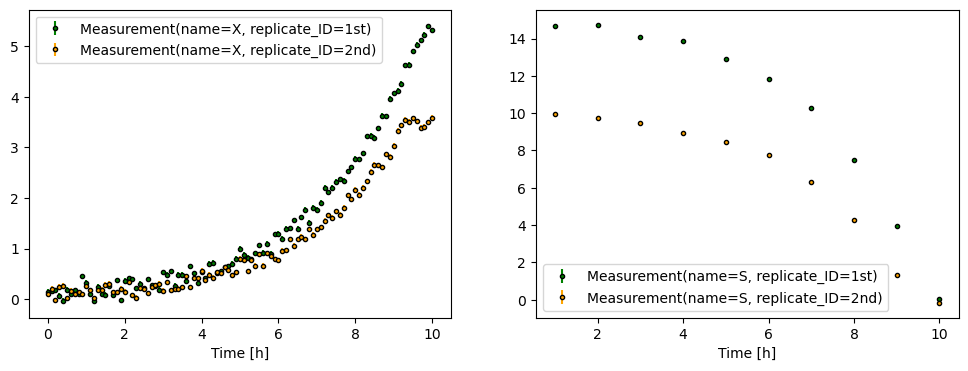
As a running example, we use the SimpleBatch process model introduced in Notebook 1 to create an artificial data set of two replicates.
# create 2 artificial datasets
def make_experiment(parameters, model: FmuModel, original_data: pd.DataFrame, error_model: BaseErrorModel = LinearErrorModel(), rID: str = datatypes.Constants.SINGLE_ID, resample=4):
    simulation = model.simulate(t0=0, t_end=10, stepsize=0.1, parameters=parameters)

    measurements = []
    for obs in original_data.columns:
        model_prediction = simulation[obs]
        # get timepoints of measurements from datesheet above
        timepoints = original_data[obs].dropna().index
        values = model_prediction.interpolate(timepoints)
        # get noisy values by resampling the data according to erro models distribution
        for _ in range(resample):
            values = error_model.get_sampling(values, 1)[0]

        measurements.append(
            datatypes.Measurement(
                name = model_prediction.name,
                timepoints=timepoints,
                values=values,
                error_model=error_model,
                replicate_ID=rID
            )
        )
    return datatypes.Experiment(measurements, replicate_ID=rID)


# create noisy data
artificial_data = dict()
for r_ID in replicate_IDs:
    replicate_parameters = parameter_mapping.replicate_handling(
        replicate_ID=r_ID
    )

    artificial_data[r_ID] = make_experiment(parameters=replicate_parameters, original_data=data, model=SimpleBatchModel, error_model=LinearErrorModel(offset=0.05), rID=r_ID)

# plot data
fig, axes = plt.subplots(
    ncols=2,
    nrows=1,
    figsize=(12, 4)
)

for (r_ID, experiment), color in zip(artificial_data.items(), ['green', 'orange']):
    for ax, measurement in zip(axes, experiment.measurements):
        visualization.plot_measurement(ax=ax, measurement=measurement, color=color, ecolor=color)
        ax.set_xlabel('Time [h]')
        ax.legend()
Defining unknown parameters and their bounds is done analogously to the example above, where we passed a dictionary of parameters to the replicate_handling function above by referring to a local name.
display(parameter_mapping.mapping)

bounds = {
    'X0_1st': [0.05, 0.2],
    'X0_2nd': [0.05, 0.2],
    'S0_1st': [1, 20],
    'mu_max': [0.2, 0.7]
}
| local name | value | ||
|---|---|---|---|
| global name | replicate ID | ||
| Ks | 1st | Ks | 0.010 |
| 2nd | Ks | 0.010 | |
| S0 | 1st | S0_1st | 15.000 |
| 2nd | S0 | 10.000 | |
| X0 | 1st | X0_1st | 0.110 |
| 2nd | X0_2nd | 0.085 | |
| Y_XS | 1st | Y_XS | 0.350 |
| 2nd | Y_XS | 0.350 | |
| mu_max | 1st | mu_max | 0.400 |
| 2nd | mu_max | 0.400 |
4.2.2 Parallelized paramter estimation#
# create an Estimator instance
estimator = Estimator(
    data=artificial_data,
    model=SimpleBatchModel,
    parameter_mapping=parameter_mapping,   # the parameter mapping
    bounds=bounds,
    t = [0, 10, 0.1]            # t_start, t_end, stepsize_solver for simulation
)

# estimate
estimates, est_info = estimator.estimate(
    method='de',
    max_iter=1000,
    n_jobs=4,
)

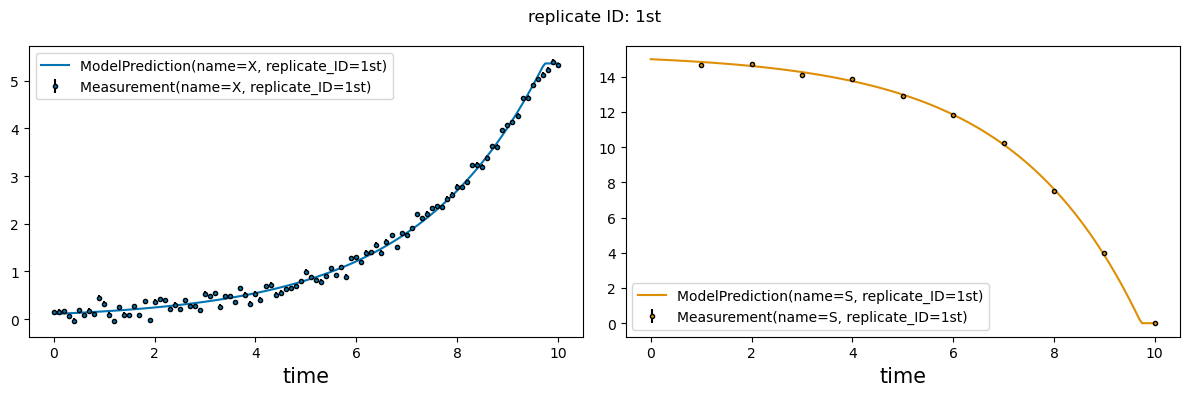
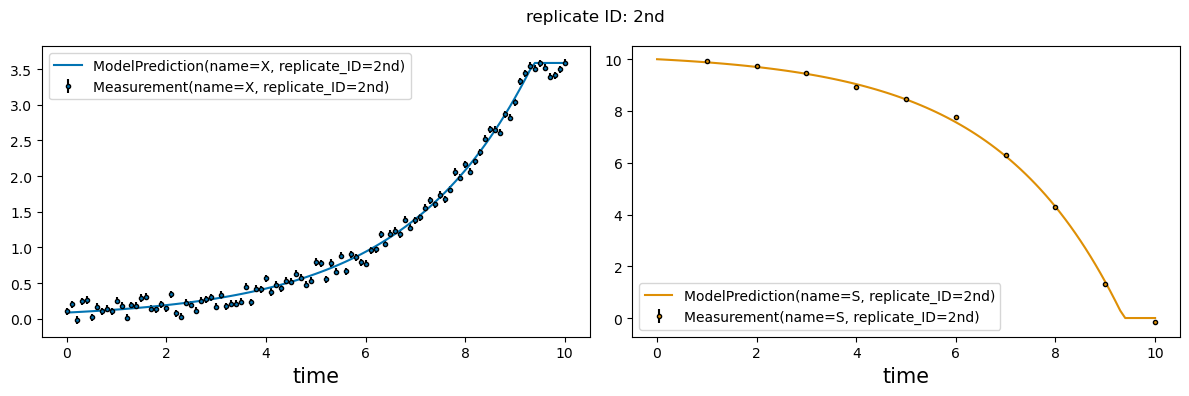
_ = visualization.plot_estimates(estimates=estimates, estimator=estimator, only_measured=True)
c:\Users\Tobia\miniforge-pypy3\envs\testim8\lib\site-packages\scipy\optimize\_differentialevolution.py:487: UserWarning: differential_evolution: the 'workers' keyword has overridden updating='immediate' to updating='deferred'
  with DifferentialEvolutionSolver(func, bounds, args=args,