1 Modeling & Simulation#
from estim8.models import FmuModel
from estim8.visualization import plot_simulation
1.1 Mathematical model formulation#
The workflow is demonstrated using a simple Ordinary Differential Equation (ODE) model from the field of biotechnology.
Here, growth of a microbial strain (biomass) in batch culture can be described in the form
where the biomass is denoted as \(X(t)~[g~L^{-1}]\) with initial concentration \(X_{0}\), and the specific growth rate is denoted as \(\mu(t)~[h^{-1}]\).
By taking a black-box approach and assuming a single finite carbon and energy source denoted as \(S(t)~[g~L^{-1}]\), the growth rate can be modelled by a Monod-type kinetic in the form
where \(\mu_{max}~[h^{-1}]\) denotes the strain and substrate specific maximum growth rate, and \(K_S~[g~L^{-1}]\) the half-maximum saturation constant.
The depletetion of \(S(t)\) in dependence of microbial growth can then be modelled as
where \(Y_{XS}~[g_X~g_S^-1]\) denotes the biomass specific yield coefficient.
1.2 Model implementation#
The model is implemented using the modeling language Modelica as shown below. OpenModelica offers an open-source and interactive environment for this purpose.
model SimpleBatch

  // define real states
  Real X(start = X0, fixed = true);
  Real S(start = S0, fixed = true);
  Real mu;

  // define variables
  parameter Real X0 = 0.1;
  parameter Real S0 = 10;
  parameter Real mu_max = 0.5;
  parameter Real Ks = 0.01;
  parameter Real Y_XS = 0.5;

equation
  der(X) = mu*X;
  der(S) = -mu*X/Y_XS;
  mu = mu_max*S/(Ks + S);

// prevent negative states
if (S<=0) then
  S=0;
 end if;

end SimpleBatch;
To apply this model with estim8, it has to be exported as a Functional Mockup Unit (FMU). Both FMI types Co-Simulation and Model-Exchange are supported.
Note: FMU compilation is os specific, the SimpleBatch.fmu used in this notebook is compiled for Windows. Please checkout the docs on FMU export
1.3 Simulation with estim8.FmuModel#
The FmuModel class offers a Python-based simulation interface for FMUs. For initialization, simply pass the FMU’s filepath. Additional keyword arguments are:
Kwarg |
type |
description |
|---|---|---|
fmi_type |
str |
The FMI type used for Simulation. Supported are “ModelExchange” (default) and “CoSimulation”. |
default_parameters |
dict |
A dictionary in form {“param”: val} to define default parameters. |
r_tol |
float |
Relative tolerance for the ‘CVode’ solver and co-simulation of FMUs. Default is \(1e^{-4}\). |
SimpleBatchModel = FmuModel(r'../../../tests/test_data/SimpleBatch.fmu')
1.3.1 Managing model properties#
Model parameters#
The parameters are accessible in form of a dictionary via the class property. To change model parameters, simply redefine the values of parameter keys.
print('Parameters before: \n', SimpleBatchModel.parameters)
# change a single parameter, e.g. mu_max
SimpleBatchModel.parameters['mu_max'] = 0.4
print("\nParameters after changing:\n", SimpleBatchModel.parameters)
Parameters before:
 {'Ks': 0.01, 'S0': 10.0, 'X0': 0.2, 'Y_XS': 0.35, 'mu_max': 0.4}

Parameters after changing:
 {'Ks': 0.01, 'S0': 10.0, 'X0': 0.2, 'Y_XS': 0.35, 'mu_max': 0.4}
Simulation flags#
Both fmi_type and r_tol can be changed using the property setter methods.
print(f'Before:\n FMI type: {SimpleBatchModel.fmi_type},  r_tol={SimpleBatchModel.r_tol}')
# change both values
# SimpleBatchModel.fmi_type = 'CoSimulation'
SimpleBatchModel.r_tol = 1e-8

print(f'After:\n FMI type: {SimpleBatchModel.fmi_type},  r_tol={SimpleBatchModel.r_tol}')
Before:
 FMI type: ModelExchange,  r_tol=0.0001
After:
 FMI type: ModelExchange,  r_tol=1e-08
1.3.2 Forward simulation#
The model can be simulated using the class method simulate, which at least requires the following arguments:
arg |
type |
description |
|---|---|---|
t0 |
float |
Start time of the simulation |
t_end |
float |
End time of the simulation |
stepsize |
float |
Stepsize of the DAE solver |
Additional keyword arguments comprise:
kwarg |
type |
description |
|---|---|---|
parameters |
dict[float] |
Parameters applied in simulation. If not specified, the class property |
observe |
list[str] |
Quantitites to observe. Default is None, which means all observable quantities within the model are used. |
r_tol |
float |
Relative solver tolerance. Default is None, which means the class property |
solver |
str |
Solver to use in ModelExchange. Default is Cvode. |
replicate_ID |
str|None |
Replicate ID. Default is |
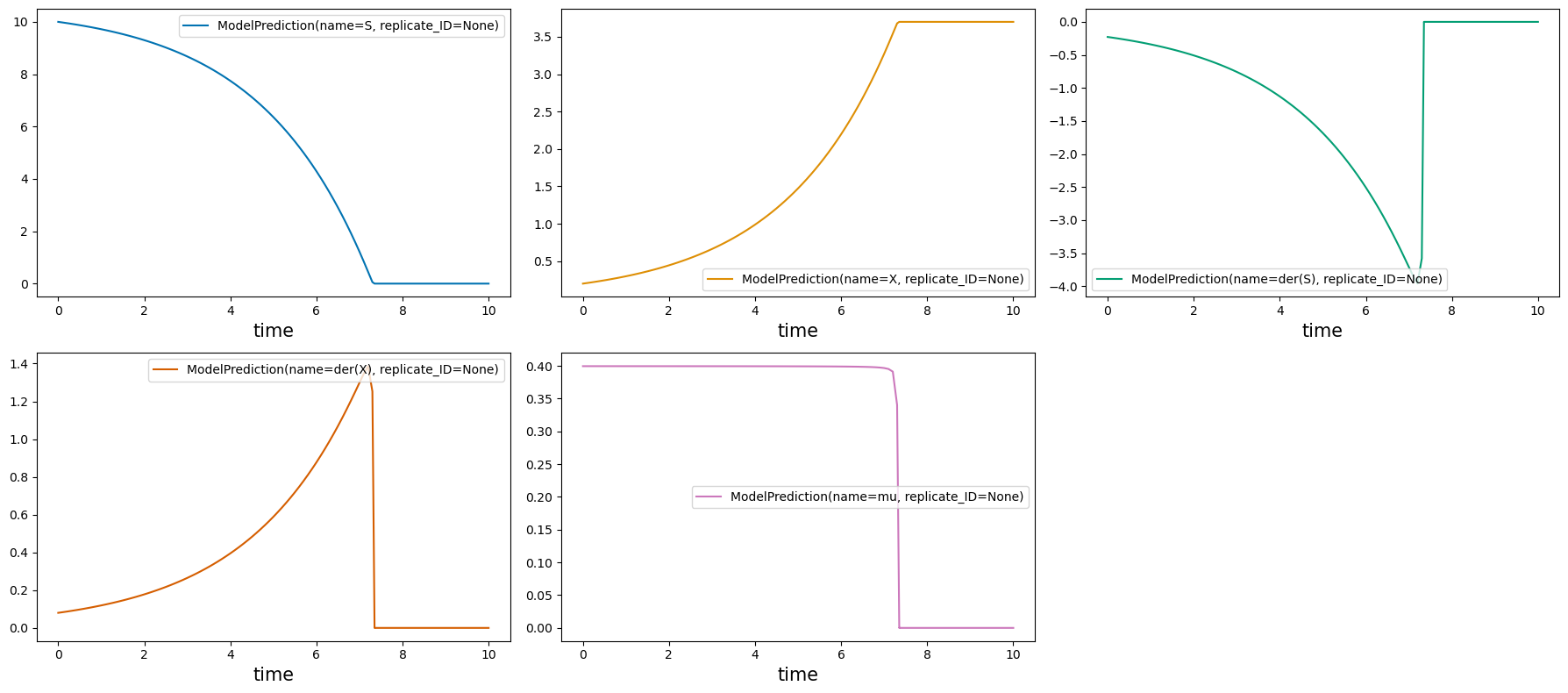
The method returns a Simulation object, which contains a list of ModelPredictions.
# simulation using default values and settings
simulation = SimpleBatchModel.simulate(
    t0= 0,
    t_end= 10,
    stepsize=0.1,
    )
_ = plot_simulation(simulation=simulation, observe=None)